The VALIANT

Monday, 26 January 2009

Women forbidden to eat in Pakistan restaurants


Sunday 25th January, 2009


The Taliban has warned women in Quetta, Paksitan, to stop frequenting restaurants.

Recently, a number of restaurants in Quetta stopped serving female customers under pressure from religious hardliners, who have the support of the Taliban.

A number of popular eateries have put up boards that say: "For gentlemen only. Women not allowed."

Hardliners believe that men and women socialise only for immoral purposes, with shops and restaurants becoming dating places for both girls and boys.

Female customers have expressed their outrage over the move, calling the restriction sheer discrimination.

After putting numerous restrictions on women in the Swat Valley, the Taliban influence is increasingly posing a threat to the freedom of women across the rest of Pakistan.

The Daily Times has reported the Taliban enjoys the overwhelming support of some sections of the population, including many ministers of the provincial coalition government.

Recently, video and CD shops and Internet cafes were attacked with bombs, and threats were issued.

Thursday, 8 January 2009

Grief and Rage at Stricken Gaza School

Abid Katib/Getty Images
Mouen Deb, left, mourned with relatives beside the bodies of two of his children and his wife, who were killed when Israeli shells exploded near a United Nations school in Jabaliya in northern Gaza. More Photos >


By TAGHREED EL-KHODARY
Published: January 7, 2009


JABALIYA, Gaza — The bodies of the children who died outside the United Nations school here were laid out in a long row on the ground. Some were wrapped in the vivid green flag of Hamas, some were in white shrouds, and some were in the yellow flag of Fatah, which is rarely seen these days in Hamas-run Gaza.

Hundreds of Gazans crowded around, staring at the little faces, some of them with dark eyes still open, but dulled.

Abdel Minaim Hasan, 37, knelt, weeping, next to the body of his eldest daughter, Lina, 11, who was wrapped in a Hamas flag. “From now on I am Hamas!” he cried. “I choose resistance!” But then he cursed Arab nations for ignoring the plight of the Gazans. “The Arabs are doing nothing to protect us!” he shouted.

The streets were crowded Tuesday evening when the mortar shells struck, Mr. Hasan said. “We were in a United Nations school, we were so far from the tanks.” There were many children around, and he gave Lina a shekel to run to a nearby grocery store. She was hit by shrapnel and died.

Some 280 families — 1,674 people — had been seeking shelter inside the school, Al Fakhura, according to the United Nations Relief and Works Agency, which helps Palestinian refugees and their descendants and which runs the school. Most came from farther north in Gaza, near Beit Lahiya, where the fighting has been intense, an hour’s walk away. Israeli forces ordered them to evacuate their homes for their own safety.

But Al Fakhura, set in the northern part of the densely packed Jabaliya refugee camp north of Gaza City, is in a crowded neighborhood full of Hamas fighters. Israel said that a preliminary investigation showed that mortar fire from the school compound prompted Israeli forces to return fire. The Israeli mortar rounds killed as many as 40 people outside the school; Palestinian hospital officials said Tuesday that 10 of the dead were children and 5 were women.

Residents of the neighborhood said two brothers who were Hamas fighters were in the area at the time of the attack. The military identified them as Imad Abu Asker and Hassan Abu Asker, and said they had been killed. But the residents also said the mortar fire had not come from the school compound, but from elsewhere in the neighborhood.

The director of the United Nations relief agency in Gaza, John Ging, who was not at the school when it was attacked, denied that Hamas fighters had been taking shelter in the school or using its premises. “There are no military people inside the school; it is fully controlled,” he said.

Mr. Ging put the death toll at 40 and said 15 more people were critically wounded and 40 others less seriously wounded. He called for an international investigation. “Those who died or were injured deserve accountability,” he said.

Mr. Ging spoke at the school during a three-hour lull in the fighting on Wednesday. Israel’s Foreign Ministry announced that a lull would take place every other day to allow humanitarian organizations to deliver supplies and Gazans to emerge from their houses and shelters to shop.

But while there is food, Gazans are running out of cash to buy it, with banks shut and A.T.M.’s empty and nonfunctional because of a lack of electricity.

The lull was also used for funerals, and a senior Hamas official, Mushir al-Masri, emerged from hiding to congratulate those he called martyrs. Some parents shook his hand; some stared at him coldly. On a loudspeaker, a man praised the dead and said: “What Israel is doing is bringing us unity again! We are all together!”

That idea appeared to explain the willingness of Hamas to have Fatah flags in such evidence.

Halfway along the row of bodies — uncountable in the press of the mourning crowd — Huda Deed was weeping. She lost nine members of her extended family, ages 3 to 25. “Look, they’ve lined them up like a ruler!” she said, inconsolable. But when asked for an interview by Al Aksa television, the Hamas channel, she refused.

Israel blames Hamas for civilian casualties, saying it knowingly endangers civilians by operating among them. Asked later about the presence of Hamas fighters in the streets around the school, Ms. Deed avoided a direct answer, but implied that her heart was not with Hamas. “We want to live like everyone else in the world,” she said.

Inside the school, Shaaban Hasouni, 47, said he came from Beit Lahiya on Sunday with eight members of his family, ages 2 to 29 years old. The Israelis had told them to evacuate, first in calls to their cellphones and then with leaflets and loudspeakers, he said. They were supposed to hold up white sheets as they evacuated. But he said he and his family left their home only when Israeli forces fired some sort of gas into it. “I couldn’t see, I didn’t know what it was, but we escaped,” he said.

Mr. Hasouni was able to make a quick trip home on Wednesday morning and came back with mattresses and blankets, saying that it was so cold, even with 40 people in every classroom, that his children could not stand it.

Asked about fighters, he said: “Of course we don’t want them around us. But we don’t know who they are, we don’t know their faces. And they wear normal clothes.”

Mahmoud al-Sous, 39, arrived on a donkey cart with blankets, mattresses, water and clothes. “My children were dying from the cold,” he said. “After two days I couldn’t stand it, so I risked going back to bring these things.”

Atif Suboh, 25, here with six members of his family, was not so lucky. Three of his cousins, ages 6, 8 and 12, he said, went back to Beit Lahiya on Wednesday morning to get blankets. They died from the shelling, he said. Asked how he could have let them go, he started to wail. “They didn’t tell us they were leaving,” he said.

If he had known that fighters would be around the school, he said, “I would never be there.”

Samira Shakoura, 40, lives in the neighborhood. “It was terrifying,” she said. “We hid in the house.”

She was defiant about the presence of Hamas. “Listen, I will always open my house to protect the fighters,” she said. “We have to be patient. We are dead anyway like this. And when Hamas runs in the elections, I’ll vote for them; they have Islam.”

Nearby, while funerals went on, people surged toward a shop 200 yards away. There were at least as many people at the shop as at the funerals. A shipment of flour had arrived.

Steven Erlanger contributed reporting from Jerusalem.

Related story:

Israel Resumes Attack After Pause for Aid Delivery (January 8, 2009)

Wednesday, 24 December 2008

Merry Christmas and Happy New Year 2009


Send this eCard

To All Readers, Visitors and Friends all over the world, I wish all of you and your family a Merry and Blessed Christmas, and Happy New year 2009.

For some 2008 will have been their best year and for others not so good. Either way you need to take a break every now and then and this is a great time to do it.

Thank you for all your support this year. I appreciate every comment and all the feedback that I get. Without you there would be no blog.

May 2009 be your best year ever.

Tuesday, 23 December 2008

Hamas threatens Israel with suicide bombers


Big News Network.com
Monday 22nd December, 2008

Hamas has told Israel it will not rule out sending suicide bombers to Israel if military operations in the Gaza Strip are escalated.

A Hamas Gaza spokesman has warned the Israeli government that the Palestinian resistance will use every available means to defend its people in the face of the Israeli aggression, including martyrdom operations.

Israel has been debating a large-scale military operation in the Gaza Strip in response to an increase in rocket fire from over the border.

Militants, mainly from the Islamic Jihad, have launched over 60 missiles and mortars at southern Israel since a truce was declared void last Friday.

Welcome to wingnut world, where war crimes go unreported

(Op-ed) Brad Friedman - The Guardian
Tuesday 23rd December, 2008

Noting the war crimes now known and admitted to by George Bush and Dick Cheney, George Washington University's highly-respected constitutional law professor Jonathon Turley asked MSNBC's Keith Olbermann last week: "If someone commits a crime and everyone's around to see it and does nothing, is it still a crime?"

The US torture policy approved by George Bush and Dick Cheney should spark a public outcry.
So where's the outrage? And what media is reporting it? Don't Americans care about war crimes?
Of course they do. But only if they know about them.


The discussion came in the wake of a new bipartisan US Senate report that found that Bush was responsible for approving torture and abuse at the Abu Ghraib prison in Iraq and Cheney's admission during an ABC interview that he helped to approve torture and abuse in interrogations.

During the interview, Turley mentioned that it'll be up to the citizens whether or not any action is actually taken to prosecute those who committed these crimes. "It will ultimately depend on citizens, and whether they will remain silent in the face of a crime that's been committed in plain view," Turley suggested. "It is equally immoral to stand silent in the face of a war crime and do nothing, and that is what the citizens are doing."

But is there any real basis for his well-meaning argument that accountability could possibly be brought by popular demand? Unfortunately, as the media has been virtually silent about what may be the most offensive crimes ever committed by an executive branch in the US (just as silent as they were during the lead-up and follow-through of the Iraq war, when those same officials sent our nation into war on the basis of demonstrable lies), it's bloody unlikely that most citizens will even learn about these scandals, much less take action on them. And if they did, who would bother to report it? As Turley said: "There's this gigantic yawn as we hear about a war crime on national television being discussed matter-of-factly by the vice-president."

But how much can citizens actually do, particularly with the sparse amount of information they've been presented? They hit the streets to protest by the millions, prior to and during the Iraq war, and the bulk of the media didn't bother to even cover it.

I'm currently driving through Oklahoma (passenger seat) as I write this. Republicanist Sean Hannity is yammering away, misinforming listeners on the radio, and a station promo just announced he'll be followed by Michael Savage for three hours, then Laura Ingraham for three hours, then John Gibson for three hours. Rightwing nuts all. I'm guessing Rush Limbaugh was on before Hannity. So, in those 15 consecutive hours of rightwing talk – on our publicly owned airwaves – who exactly will be informing citizens of the documented evidence of war crimes committed by Bush and Cheney?

Yes, if the citizens began throwing shoes everywhere by the millions, someone in the corporate mainstream media might cover it somewhere. But without the daily barrage of a real media, covering the topics that actually matter, with the attention they deserve, the citizens are often clueless, and otherwise virtually powerless, in this wingnut-fed media world we've allowed to be created around us.

If you doubt any of that, just ask yourselves what we'd be listening to on talk radio, and thus watching on the cable news network, and thus see debated on the floor of Congress, had a bipartisan panel found that President Bill Clinton had approved war crimes that hastened the deaths of thousands of US troops, just before vice-president Al Gore went on ABC News to admit it, and even crow about it. You suppose that coverage might help inspire a citizen uprising in that case? You bet. But it is, for the moment, a wingnut world. We just live in it.

Do Americans simply not care about war crimes? Of course they do. But not unless they know about them, and not unless the argument that they occurred, and the evidence of it, is presented in the detail that such an issue merits. While a small number of outraged citizens who take action actually can make enormous differences on the local level, accountability for international war crimes requires an untiring, responsible, focused media to inspire the mobilisation of a nation.

Such as it is, these crimes were committed by Republicans, and didn't overtly involve sex, so they don't actually matter.

Arguably, as Turley noted, none of it even happened at all. "I think that's really the argument of this administration: 'It can't be a crime because no one's prosecuted us for it.'"

It's good to be king.

Friday, 19 December 2008

Brazil to boost troops in Amazon, weapons industry


By MARCO SIBAJA ; Associated Press Writer
Published: December 18th, 2008 04:42 PM | Updated: December 18th, 2008 07:22 PM

BRASILIA, Brazil -- Brazil will beef up troops in its vast Amazon rain forest, build nuclear and conventional submarines to protect offshore oil fields and modernize its weapons industry under a national defense plan outlined in a report Thursday.

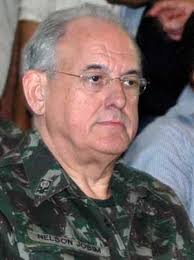
Strategic Affairs Minister Roberto Mangabeira Unger (left) said the plan calls for investments to modernize and equip the armed forces, create a rapid deployment force and update its weapons industry. Officials did not provide a cost estimate.

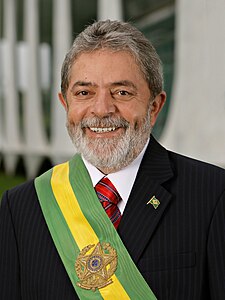
"The plan includes the restructuring of Brazil's weapons industry to guarantee the supply of defense material without depending on foreign suppliers," President Luiz Inacio Lula da Silva (right) said at a ceremony to unveil the plan.

Defense Minister Nelson Jobim (left) said the government will increase the number of troops in the Amazon from 17,000 to 25,000, though he did not offer a timetable.

The report says Brazil "will develop its capacity to design and manufacture conventional and nuclear submarines" to protect its coastline, as well as recently discovered offshore oil reserves that could hold up to 55 billion barrels of oil.

"Investments will be accelerated and partnerships established to execute the nuclear submarine project," the report said.

France has promised to provide Brazil with technology to build the Scorpene diesel attack submarine, which officials hope to use to develop what would be Latin America's first nuclear-propelled sub.

Brazil's defense industry was the largest in the developing world in the mid-1980s, but it declined along with demand after the end of the Cold War.

In 1990, the country's two largest arms manufacturers, Engesa and Avibras, sought protection from creditors for debts of about US$200 million.

Brazil says any defense partnership must help the country develop its weapons industry.

"We will not simply be buyers or clients, but partners," Mangabeira said earlier this year. "Any arrangement into which we will enter must, in principle, contemplate a significant element of research and development in Brazil."

Wednesday, 17 December 2008

Arab world lauds Iraqi TV journalist' shoe-hurling at Bush


ANI - Tuesday 16th December, 2008

Baghdad, Dec.16 : The Iraqi television journalist who hurled his shoes at visiting US President George W. Bush in Baghdad on Sunday, is being feted around the Arab world for having the courage to showcase the rage in the region over a war that is still regarded as unpopular.

President Bush, on a surprise trip to Iraq and Afghanistan, got a taste of dissent at a Baghdad press event Sunday when an Iraqi journalist threw shoes at him, forcing him to duck.

In Saudi Arabia, a newspaper reported that a man had offered 10 million dollars to buy just one of what has almost certainly become the world's most famous pair of black dress shoes.

A daughter of Colonel Muammar el-Qaddafi, the Libyan leader, reportedly awarded the shoe thrower, Muntader al-Zaidi, a 29-year-old journalist, a medal of courage.

According to the New York Times, in Sadr City, people calling for an immediate American withdrawal removed their footwear and placed the shoes and sandals at the end of long poles, waving them high in the air. And in the southern Iraqi city of Najaf, people threw their shoes at a passing American convoy.

In street-corner conversations, on television and in Internet chat rooms, the subject of shoes was inescapable throughout much of the Middle East on Monday, as was the defiant act that inspired the interest: a huge and spontaneous eruption of anger at President Bush on Sunday in his final visit here.

Some deplored Zaidi's act as a breach of respect or of traditional Arab hospitality toward guests, even if they shared the sentiment.

"Although that action was not expressed in a civilized manner, it showed the Iraqi feelings, which is to object to the American occupation," said Qutaiba Rajaa, a 58-year-old physician in Samarra, a Sunni stronghold north of Baghdad.

Zaidi, who remained in custody Monday, provided a rare moment of unity in a region often at odds with itself.

In Syria, Zaidi's picture was shown all day on state television, with Syrians calling in to share their admiration for his gesture and his bravery.

In central Damascus, a huge banner hung over a street, reading, "Oh, heroic journalist, thank you so much for what you have done."

In Lebanon, reactions varied by political affiliation, but curiosity about the episode was universal. An American visitor to a school in Beirut's southern suburb, where the Shiite militant group Hezbollah is popular, was besieged with questions from teachers and students alike, who wanted to know what Americans thought about the insult.

The instantly mythic moment took place Sunday night at a news conference by President Bush and Prime Minister Nuri Kamal al-Maliki in Baghdad's Green Zone, a session meant partly to trumpet recent security gains in Iraq.

As Bush was speaking, Zaidi rose abruptly from about 12 feet away, reared his right arm and fired a shoe at the president's head while shouting in Arabic: "This is a gift from the Iraqis; this is the farewell kiss, you dog!"

Bush deftly ducked and the shoe narrowly missed him. A few seconds later, the journalist tossed his other shoe, again with great force, this time shouting, "This is from the widows, the orphans and those who were killed in Iraq!" Again, the shoe sailed over the president's head.

Zaidi was subdued by a fellow journalist and then beaten by members of the prime minister's security detail, who hauled him out of the room in his white socks. Zaidi's cries could be heard from a nearby room as the news conference continued.

A number of Iraqis said they were dismayed by what Zaidi had done.

Zaidi, who has not been formally charged, faces up to seven years in prison for committing an act of aggression against a visiting head of state.

A statement from the Maliki's government described the shoe-throwing as a "shameful, savage act that is not related to journalism in any way."

It called on Al Baghdadia, the Cairo-based satellite television network for which Zaidi works, to publicly apologize.

But as of Monday night, no apology from the network had been forthcoming.

Facebook closes down hate site


Big News Network.com
Tuesday 16th December, 2008

Internet site Facebook has shut down a web site in which a group of Serbians inserted celebratory messages on the massacre of 8,000 Muslims in Srebrenica.

After online appeals from nearly 20,000 Facebook subscribers, the company closed the site.

A Serbian group called Noz Zica Srebrenica celebrated the detention and killing of around 8,000 Muslim men and boys in Srebrenica in 1995 by Bosnian Serb forces.

A Facebook spokesman said the message content had violated Facebook terms of use.

Friday, 12 December 2008

Report says Rumsfeld allowed torture


Big News Network.com
Thursday 11th December, 2008

A US report, following a two year investigation, has declared former US Defence Secretary Donald Rumsfeld and other US officials allowed the use of torture on foreign detainees.

The report says Rumsfeld "redefined the law" to allow the abuse of detainees in US custody.

The authors of the report, Senator Carl Levin, chairman of the Armed Services Committee, and Senator John McCain, said the abuse could not simply be attributed to the actions of “a few bad apples” acting on their own.

They said: "The fact is that senior officials in the United States government solicited information on how to use aggressive techniques, redefined the law to create the appearance of their legality, and authorized their use against detainees."

Even though the Bush administration had suggested that the use of torture techniques came from interrogators who had requested tougher methods for al-Qaeda and Taliban members, the report concluded that the use of torture originated from a February 2007 memo from President Bush that said the Geneva Convention did not apply to non-government fighters.

China considers sending navy to disperse pirates


Big News Network.com
Friday 12th December, 2008

The Chinese navy may be sent to the Gulf of Aden to carry out an offensive against Somali pirates.

China is currently deciding whether to send its navy to fight piracy off the coast of Somalia, after two of its vessels were captured last month.

Chinese national defence experts have been discussing the possibility with foreign affairs diplomats following the most recent seizure of a Hong Kong-flag ship with a 25-member crew.

The China Daily has reported the diplomats feel the government should use caution and only go to the Gulf of Aden region within U.N. rules.

The United Nations has adopted three resolutions since July asking the international community to respond to the piracy problem off Somalia.

Sunday, 30 November 2008

Terrorists posed as Malaysian students

[In this Wednesday, Nov. 26, 2008, file photo, a gunman walks at the Chatrapathi Sivaji Terminal railway station in Mumbai, India. Teams of gunmen stormed luxury hotels, a popular restaurant, hospitals and a crowded train station in coordinated attacks across India's financial capital,taking Westerners hostage and leaving parts of the city under siege. - AP pic]

MUMBAI, Nov 30 - A sensational revelation has emerged from a terrorist caught alive by Indian troops: The attack on Mumbai's top hotels was meant to be India's Sept 11.

Azam Amir Kasav - some reports have his name as Ajmal Amir Kasab - confessed that part of the plot called for him and his fellow terrorists to carry out a replay of the destruction of Islamabad's Marriott Hotel, in targeting Mumbai's Taj Mahal Hotel.

The Marriott was blown up by militants in September, an attack that killed more than 50 people.

According to a report in The Times of India, Azam said the attacks on the Taj and The Oberoi Trident were aimed to create a "Sept 11 in India", a reference to the coordinated attacks by Al-Qaeda on the United States in 2001. They involved the crashing of hijacked planes into the Twin Towers in New York and the Pentagon that left nearly 3,000 people dead.

The confessions of the clean-shaven, fluent English-speaking 21-year-old Pakistani have given investigators a clearer picture of what had happened last Wednesday.

Azam said he was member of the Lashkar-e-Taiba, but the Kashmir- based Pakistani militant group has denied any role in the attacks.

Founded as a guerilla group to fight the Indian army in Kashmir, the group was banned by the Pakistani government after the Sept 11, 2001 attacks, but reportedly continues to enjoy the backing of some Pakistani politicians and security officials.

A native of Faridkot in Pakistan- occupied Kashmir, Azam revealed the names of his fellow terrorists, all Pakistani citizens: Abu Ali, Fahad, Omar, Shoaib, Umer, Abu Akasha, Ismail, Abdul Rahman (Bara) and Abdul Rahman (Chhota).

But the 10 men were apparently not the only ones directly involved: Another group, he claimed, had checked themselves into hotels four days before, waiting with weapons and ammunition they had stockpiled in the rooms.

The 10 men in Azam's group were chosen well: All were trained in marine warfare and had undergone a special course conducted by the Lashkar-e-Taiba. Preparations were also detailed, and started early.

Azam and eight others in the team made a reconnaissance trip to Mumbai several months before the attacks, pretending to be Malaysian students. They rented an apartment at Colaba market, near one of their targets, the Nariman House.

The chief planner of the attacks also visited Mumbai a month before to take photographs and film strategic locations, including the hotel layouts.

Returning to Pakistan, the chief plotter trained the group, telling them to 'kill till the last breath'.

Surprisingly, the men did not expect themselves to be suicide terrorists. Azam said they had originally planned to sail back on Thursday - the recruiters had even charted out a return route, stored on a GPS device.

On the evening of Nov 21, Azam's group set off from an isolated creek in Karachi in a boat. The next day, a large Pakistani vessel with four Pakistanis and crew picked them up, whereupon the group was issued arms and ammunition.

Each man in the assault team was handed six to seven magazines of 50 bullets each, eight hand grenades, one AK-47 assault rifle, an automatic loading revolver, credit cards and a supply of dried fruit. They were, as some media put it, in for the long haul.

A day later, the team came across an Indian-owned trawler, Kuber, which they boarded. They killed four of the fishermen onboard, dumped their bodies into the sea, and forced its skipper Amarjit Singh to sail for India.

The next day, they beheaded the skipper, and one of the gunmen, a trained sailor, took the wheel and headed for the shores of Gujarat, India.

Near Gujarat, the terrorists raised a white flag as two officers of the coast guard approached.

While the officers questioned them, one of the terrorists grappled with one of them, slit his throat and threw his body into the boat. The group then ordered the other officer to help them get to Mumbai.

On Nov 26, the team reached the Mumbai coast.

Four nautical miles out, they were met by three inflatable speedboats. They killed the other coast guard officer, transferred into the speedboats and proceeded to Colaba jetty as dusk settled.

The Kuber was found later with the body of the 30-year-old captain onboard.

At Badhwar Park in Cuffe Parade - just three blocks away from Nariman House - the 10 men got off, stripped off the orange windbreakers they had been wearing and made sure to take out their large, heavy backpacks.

It was there that they were spotted by fisherman Prasan Dhanur, who was preparing his boat, and harbour official Kashinath Patil, 72, who was on duty nearby.

"Where are you going?" Patil asked them. "What's in your bags?"

The men replied: "We don't want any attention. Don't bother us."

Thinking little of it, Dhanur and Patil, who said they did not see the guns hidden in the backpacks, did not call the police, and watched the 10 young men walk away.

Then the carnage started.

On hitting the ground, the 10 men broke up.

Four men headed for the Taj Mahal Hotel, two for The Oberoi Trident, two for Nariman House and two - Azam and Ismail - for the Chhatrapati Shivaji Terminus by taxi.

At the railway station, Azam and his colleague opened fire, targeting Caucasian tourists while trying to spare Muslims.

The two gunmen also destroyed the CCTV control room, throwing grenades into it.

It was here that Azam was photographed, dressed in light-grey combat trousers and sneakers, a rucksack on his back, toting his AK-47.

According to one security expert, the way he carried the assault rifle revealed months of training.

The two men left the main hall of the railway station littered with bodies and pools of blood, then moved on to Metro Cinema and then to the Girgaum Chowpatty area in a stolen Skoda.

It was there that their plans started to unravel.

At the Girgaum Chowpatty area, Azam and Ismail were intercepted by anti-terror troops from the Gamdevi police station, and they ended up trading shots.

Azam managed to shoot dead assistant police inspector Tukaram Umbale, while one of them also gunned down anti-terror squad chief Hemant Karkare.

Ismail, however, was eventually killed, while Azam himself was shot in the hand. Pretending to be dead, he fell, and the two men were taken to Nair Hospital.

But police soon spotted him breathing and quickly evacuated the hospital's casualty ward, and brought in the anti-terror squad to interrogate him.

At first, Azam remained tight-lipped, but the sight of Ismail's mutilated body broke his resolve.

Pleading with medical staff to save his life, he said: "I do not want to die. Please put me on saline."

The bullet in his hand was removed, and after his condition had stabilised, Azam was moved to another location on Thursday for more interrogation.

Reports, however, say that the grilling at the hospital had been so intense that at one point, he pleaded with the police and medical staff to kill him.

He said: "Now, I don't want to live." - The Straits Times

Saturday, 29 November 2008

Jihadi Terror in Mumbai


Written by Anand Kumar
Friday, 28 November 2008


Driving a further wedge between India and Pakistan

The 25-odd attackers who strew death, terror and chaos in India’s financial capital of Mumbai Wednesday are believed to have been dropped onto speedboats from ships in the Arabian Sea, officials say, going after Americans, Britons and Jews. The attackers, identified as Pakistanis, are either an Al Qaeda-allied group, officials say, or sent by Pakistan’s notorious Directorate for Inter-Services Intelligence, or ISI.

As a weapon to kill any possible rapprochement between Indian and Pakistan, the attackers, whoever they were, couldn't have done much better. In addition, the attacks seem almost certain to fuel the already distressing rise of communalism in India and make the country's 150-odd million Muslims a target. (See Asia Sentinel: Nov. 11, The Rise of India's Saffro-Nazis)

An Indian soldier runs to take cover in front of the Taj Mahal hotel as Indian troops and militants battle in Mumbai, India, yesterday. Teams of gunmen stormed luxury hotels, a popular restaurant, hospitals and a crowded train station in coordinated attacks across India's financial capital, taking Westerners hostage and leaving parts of the city under siege. - AP pic

Indian commandoes Friday were scouring three luxury hotels room by room Friday in the aftermath of attacks that have left more than 125 people dead and nearly 350 injured, including almost all the top leaders of the Mumbai Anti-Terrorism Squad (ATS). Among the dead is ATS Chief Hemant Karkare.

Video footage captured by CCTV cameras indicates that all the attackers, clad in T-shirts and khakis, were highly trained and were heavily armed. So far 10 have been killed, with one taken alive. The arrested terrorist has been traced to Faridpur in Pakistan. One of the three speedboats seized by police was heavily laden with explosives.

After reaching Colaba fishing harbor, the attackers scattered in small groups and moved towards different targets. They targeted the city’s three prominent hotels, hospital, railway station and most importantly Nariman House, an office building that houses a Jewish center. Though the terrorists were indiscriminate in their killing, in Hotel Taj Mahal, (photo right) one of Mumbai’s most famous landmarks, they asked for British and American passport holders.

A hitherto unheard-of group calling itself "Deccan Mujahedeen" took responsibility for the attack, which is dramatically different from the anonymous bombings of the past. Previously bombs were surreptitiously planted in different localities, with attackers choosing softer targets and unsuspecting victims. But this time the attackers, armed to the teeth, were essentially on a suicide mission. The operation involved a large number of gunmen and was carefully and professionally planned. Officials said the attackers were familiar with the layout of all of the hotels and other buildings they invaded.

The attack served many objectives, creating terror in the country as well as heightening the tension between India and Pakistan and if possible creating war hysteria. They also wanted to take revenge on Britain and the United States, the main players in the War on Terror, by taking their citizens hostage or by killing them.

Although the detention of two ships in the Arabian Sea gives further credence to the involvement of Pakistan, along with the satellite phones captured from the attackers, it is possible that the Pakistani government may not be directly involved. Pakistani President Asif Ali Zardari earlier this week offered an olive branch to India, seeking to decrease tensions between the two countries.

In separate messages, Zardari and Prime Minister Yousaf Raza Gilani deplored the Mumbai attacks although Pakistan’s condemnation has started looking hollow as more and more evidence pointing towards that country’s involvement although the jihadi groups and Pakistan’s notorious Director for Inter-Services Intelligence, or ISI are almost outside its control. These attacks have managed to embarrass the Pakistan foreign minister Shah Mehmood Qureshi who was in India to "build bridges."

Certainly, the attacks could not have come at a worse time for the Manmohan Singh-led government, which already is facing severe criticism for its weak handling of terror. Indians both at home and abroad are outraged. The attacks are being termed India’s 9/11 and the government is under severe pressure for a response.

Speculation on the motive and source of the attacks varies. Indian officials have a tendency to blame the ISI for any attack that takes place on Indian soil. That doesn’t mean, however, that they didn’t have something to do with this one. The attacks took place immediately after the agency’s political wing was ordered disbanded by Zardari. US officials have been pressuring Pakistan to do something about the powerful spy agency since they concluded that the ISI was involved in a July 7 bombing of India’s embassy in Kabul.

Indian officials say the ISI might have hoped the attack would destabilize the civilian government in Pakistan and give the organization a chance to regain lost ground. Others say the restrictions placed on the ISI are hardly effective and in an earlier case when the government tried to bring the agency under the Interior Ministry the decision was almost immediately reversed.

It is also suggested that al-Qaeda or allied groups might be involved in a bid to do something spectacular to boost sagging morale after the organization lost some of its top leaders in recent US attacks. Another possibility is that successful elections in Kashmir, where voter turnout has been nearly 65 percent might have made the jihadi forces.These attacks might also have been launched with the objective of sabotaging the ongoing election process in several Indian states.

Whatever the motive, the Mumbai attacks are likely to have serious implications for India, affecting the trade and business environment. They forced closure of the country’s stock and commodity exchanges and drove up its risk premium in international credit markets. Foreign investors have already withdrawn about US$13.5 billion from the Indian stock market this year. Coming at a time, when foreign investors have been selling Indian assets, the attacks raised fears of a steeper fall in the rupee and a further blow to market confidence.

Clearly it will be negative for the sentiment at a time when the world is already looking to be highly uncertain in terms of growth prospects. The global recession is likely to bring down India’s annual gross domestic product growth rate to 7.5 percent. The attacks may well worsen the situation, particularly affecting tourism as the terrorists have attacked three major and very popular hotels of Mumbai.

India’s Commerce minister, Kamal Nath says that there is no economic component to these attacks. But the business community is far from convinced. The attacks have rattled the business community, which is now demanding tougher laws along with "stronger and firmer" leadership to tackle terrorism. Industry leaders, including heads of the apex chambers, feel the country needs to be on a high alert since their institutions are becoming vulnerable.

Though Mumbai has bounced back after earlier attacks the industry leaders are of the view that the latest attacks are different from the earlier ones and the city might take time to adjust.

Monday, 24 November 2008

Police practising selective persecution: Malaysian Bar


By Elizabeth Looi
elizabethlooi@thenutgraph.com
24 Nov 08 : 8.02PM

PETALING JAYA, 24 Nov 2008: The police acted unjustly when they detained one group for illegally gathering in public but did not arrest another, said the Malaysian Bar.

Bar president Datuk Ambiga Sreenevasan said both groups were exercising their right to freedom of assembly as enshrined in the Federal Constitution.

One assembly was held to protest against the Internal Security Act (ISA), while the other, which apparently marched from Wisma Sejarah to the Tun Razak police station in Kuala Lumpur, was to support the act.

"However, only one group was targeted, namely the anti-ISA group. We are alarmed that nine people from the group were arrested.

"The use of police force against only one group is selected persecution," Ambiga said in a statement.

She was commenting on the arrests of nine people at the gathering of the Abolish ISA Coalition (GMI) on 23 Nov in Ampang. Among those arrested included PAS vice-president Mohammad Sabu.

Ambiga called on the authorities to even-handedly protect and uphold the rights of all citizens to assemble peacefully to express their opinions.

DAP Member of Parliament for Klang Charles Santiago also said the police had practised double standards when they stood guard for the 500 people who demonstrated on 23 Nov to support the use of the ISA.

"While the police are quick to arrest opposition politicians, human rights workers, and members of the civil society [who take part in demonstrations], they act as protectors during street protests organised by ruling parties and groups which support the government.

"This is blatant double standard," he said in a statement.

Santiago added that the arrests reflect the highhandedness of the police force, abuse of power, and non-tolerance of dissent by the government.

He also called on the police to stop attacking members of the media as he was told that they were shoved and shouted at during the ISA gathering in Ampang.

Monday, 17 November 2008

Shuttle Endeavour links with space station


By MARCIA DUNN – 2 hours ago

CAPE CANAVERAL, Fla. (AP) — Space shuttle Endeavour linked with the international space station on Sunday, kicking off a huge home makeover that will allow twice as many astronauts to live up there beginning next year.

In this photo (left) released by NASA, Astronaut Steve Bowen, STS-126 mission specialist, prepares to use a camera on the middeck of Space Shuttle Endeavour during post launch activities on Friday Nov. 14, 2008. (AP Photo/NASA)

Commander Christopher Ferguson guided the shuttle to a smooth docking as the two spacecraft soared 212 miles above India. His ship's radar worked just fine, despite earlier trouble with the antenna.

Image above: The STS-126 and Expedition 18 crews greet each other.
Photo credit: NASA TV


"We understand that this house is in need of an extreme makeover and that you're the crew to do it," the space station's skipper, Mike Fincke, said as he welcomed the seven shuttle astronauts aboard.

In this photo (left) released by NASA, astronaut Chris Ferguson, STS-126 commander is seen in the commander's station on the flight deck of Space Shuttle Endeavour during post launch activities on Friday Nov. 14, 2008. (AP Photo/NASA)

His crewmate, Gregory Chamitoff, was especially excited to see Endeavour. He's been living on the space station for almost six months, and the shuttle is his ride home.

"Wow," Chamitoff exclaimed. "You look beautiful ... I am smiling from ear to ear."

Earlier in the afternoon, before Endeavour began its final approach from eight miles out, Fincke and his crew captured striking video of it and the moon, which was also prominent in many of the launch-night photos.

"It's a big day here today," Fincke said.

Once Endeavour closed to within several hundred feet, Ferguson guided it through a 360-degree backflip so Fincke and Chamitoff could take zoom-in photos of all its thermal shielding. About 200 digital images will help NASA determine whether Endeavour sustained any damage during liftoff Friday night. Fincke said he noticed nothing amiss.

In this photo (left) released by NASA shows Astronaut Eric Boe, STS-126 pilot, gives a thumbs up as he sits in the pilot's station on the flight deck of Space Shuttle Endeavour during post launch activities on Friday Nov. 14, 2008. The first-time space traveler has been flying for the Air Force since the late 1980s, (AP Photo/NASA)

Only one piece of debris has been spotted so far in launch pictures. It was probably ice and did not strike Endeavour, said LeRoy Cain, chairman of the mission management team. Flight controllers initially thought it might be one of the shuttle's thermal blankets.

NASA officials were delighted with how everything was going.

"The team down here on the Planet Earth wanted to compliment you on a well-done, very nicely done rendezvous and docking," Mission Control radioed up.

The first priority for the 10 astronauts was a crew member swap.

Astronaut Sandra Magnus moved into the space station for a 3 1/2-month stay, replacing Chamitoff. The two greeted each other with a bear hug. "Welcome to your new home," Fincke told her.

As soon as everyone embraced, Fincke declared: "On to work. Man, this place just got smaller."

Besides Magnus, Endeavour was delivering thousands of pounds of home improvement gear: an extra bathroom, kitchenette and exercise machine, two more sleeping compartments, and a fancy new recycling system for converting urine and condensation into drinking water.

In this photo (left) released by NASA, astronauts Shane Kimbrough, right, and Sandra Magnus, both STS-126 mission specialists, work with their shuttle launch and entry suits on the middeck of Space Shuttle Endeavour during post launch activities on Friday Nov. 14, 2008. (AP Photo/NASA)

NASA cannot double the size of the space station crew — currently at three — until all the new equipment is installed, checked out and working properly. The goal is to have six people living permanently on the orbiting outpost by June.

Most of the new stuff is inside a giant cylinder that Endeavour's astronauts will attach to the space station on Monday.

Endeavour and its crew will spend almost two weeks at the space station, a little longer than usual. Four spacewalks will be carried out beginning Tuesday, primarily to clean and lubricate a solar wing-rotating joint that broke down more than a year ago. It's clogged with metal shavings from grinding parts.

Thursday, 16 October 2008

Parliament: Cops scared of crooks, so base closed!


By ROYCE CHEAH

KUALA LUMPUR: A police beat base in the Chow Kit area of downtown Kuala Lumpur was closed down because it was in a location that was considered unsafe, said Home Minister Datuk Seri Syed Hamid Albar.

In a written reply to Dr Lo’ Lo’ Mohamad Ghazali (PAS-Titiwangsa), Syed Hamid said the beat base was located in a dirty area where there was a possibility of being exposed to contagious diseases.

The presence of criminals also posed a threat to the safety of police officers, he said.

Lo’ Lo’ had asked why the beat base on Jalan Haji Taib was closed considering the high number of vice-related activities in the area, as well as what kind action had been taken by the police to curb such activities.

Syed Hamid said that the police were looking for a new location to build a police beat base that would be able to give “guaranteed and continued service to the public.”

Lo’ Lo’s was the 30th question in the Order Paper and hence did not get a mention in the House during the daily one-hour Question Time. However, Dr Mohd Hatta Ramli (PAS-Kuala Krai) managed to raise it when he interjected during Azmin Ali’s (PKR-Gombak) speech during the debate on Budget 2009.

Dr Mohd Hatta said that if the police themselves felt unsafe in a beat base, then it would be even worse for the public.

“The minister has to resign if he is worried about the safety of police in that area. Maybe it would be better to put the beat base in army barracks,” he said.

Dr Mohd Hatta then managed to raise the issue again during his own debate on Budget 2009 saying that Syed Hamid’s response was not rational.

“The police are there to make a place safe. If they themselves are scared and run away, then how can we hope for others to want to be there?

“It is embarassing and that is why the criminals will always be there,” he said.

Dr Mohd Hatta said if the place is dirty, then it is up to the police to organise gotong-royong activities to clean it up or if they did not want to then they should move to Putrajaya or Parliament.

“And what is this about contagious diseases on Jalan Haji Taib? The only kind of contagious diseases that are present there are sexually-transmitted ones.

“Is the minister scared that his charges will contract such diseases? That kind of thing is a matter of choice. In any case, if this is what he is worried about then we are worried that the police are not above this.”

Dr Mohd Hatta added that the police had to be brave people and that they were a different breed altogether when facing demonstrators. He said he hoped that the minister would clarify his written answer in the House as this is not the kind of police that the people want.